End hunger, achieve food security and improved nutrition and promote sustainable agriculture
Targets
- By 2030, ensure access by all employees and students, in particular people in vulnerable situations, to safe, nutritious, and sufficient food all year round.
- By 2030, end all forms of malnutrition, including achieving, by 2025, the internationally agreed targets on stunting and wasting in our staff and students, and address the nutritional needs of pregnant and lactating women and older persons.
- By 2030, contribute with our research to increase the agricultural productivity and incomes of small-scale food producers, in particular women, farmers, pastoralists, and fishers.
- By 2030, gradually invest in research towards resilient agricultural practices that increase productivity and production, that help maintain ecosystems, that strengthen capacity for adaptation to climate change, extreme weather, drought, flooding, and other disasters, and that progressively improve land and soil quality.
- By 2030, contribute to the research that maintains the genetic diversity of seeds, cultivated plants, and farmed and domesticated animals and their related wild species, including through soundly managed and diversified seed and plant banks at the national, regional, and international levels.
- Increase research investment in rural infrastructure, agricultural research and extension services, technology development, and plant and livestock gene banks to enhance agricultural productive capacity.
Courses/modules relating to the goal
Bachelor Courses
Master Courses
- Environmental Monitoring and Planning
- Agroecology and Environmental Management
- Biochemistry and Biotechnology
- Physiology and Nutrition
- Neural Information and Robotic Systems
- Innovative Chemical and Biotechnological Processing of Plant Raw Materials
- Integrated Safety, Population and Resource Saving in Life Safety System
- Economics of Safety in Agro-Industrial Complex
- Innovative technologies in Social Welfare
Articles relating to the goal
- Voronkova, O.Y., Kurbanov, P.A., Fomin, A.A., Babkin, P.S., Matveeva, E.A., Kharina, A.A. (2020). Formation and implementation of regional targeted agro-industrial complex development programs towards integrated rural development. Entrepreneurship and Sustainability Issues, 8(1), pp. 1238-1247. DOI: 10.9770/jesi.2020.8.1(15).
- Tatarintsev, V.L., Tatarintsev, L.M., Matsyura, A.V., Bondarovich, A.A. (2020). Organization of sustainable agricultural land use based on landscape analysis. Sustainable Development of Mountain Territories, 12(3), pp. 339-348. DOI: 10.21177/1998-4502-2020-12-3-339-348.
- Voronkova, O.Y., Klochko, E.N., Vakhrushev, I.B., Sergin, A.A., Karpenko, E.Z., Tavbulatova, Z.K. (2020). Land resource management in the agro-industrial sector of Russia. International Journal of Pharmaceutical Research, 12, pp. 2087-2093. DOI: 10.31838/ijpr/2020.SP1.306.
- Bavorová M., Bednarikova Z., Ponkina E.V., Visser O. (2021). Agribusiness social responsibility in emerging economies: Effects of legal structure, economic performance and managers’ motivations. Journal of Cleaner Production, 289,125157. DOI: 10.1016/j.jclepro.2020.125157
- Pazur R., Prishchepov A.V., Myachina K., et al. (2021). Restoring steppe landscapes: patterns, drivers and implications in Russia’s steppes. Landscape Ecology, 36, pp. 407–425. DOI: 10.1007/s10980-020-01174-7
- Prishchepov A.V., Ponkina E.V., Sun Z., Bavorova M., Yekimovskaja O.A. (2021). Revealing the intentions of farmers to recultivate abandoned farmland: A case study of the Buryat Republic in Russia. Land Use Policy, 107,105513. DOI: 10.1016/j.landusepol.2021.105513
- Vorobyova V.V., Bugay Y.A. (2021). Developing Personal Subsidiary Farms in the Food Supply System of the Altai Krai. IOP Conference Series: Earth and Environmental Science, 670(1), 012001. DOI: 10.1088/1755-1315/670/1/012001
Conference Name
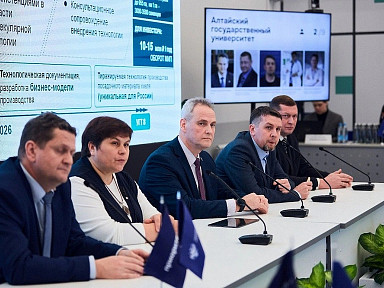
- International Forum “Biotechnologies: Science, Education, and Industry”
- III International Biotechnological Symposium “BioAsia Altai 2021”
News
-
-

-

-
-
-
-
-

-

-

-
-


Documents
- Impacting the Global Goals by Degrees - 2022 (pdf, 2.83 Mb)
- Impacting the Global Goals by DEGREEs - 2021 (pdf, 1.35 Mb)
- Impacting the Global Goals by DEGREEs - 2020 (pdf, 1.15 Mb)
- Residential and Hospitality (pdf, 194.33 Kb)
- Sustainable Food Policy (pdf, 181.74 Kb)