On November 19, in Moscow, a delegation from Altai State University, led by Rector Sergei Bocharov, presented the outcomes of the "Priority 2030" program for 2025 to the Council for Support of University Development Programs.
In defending their programs, participating universities in the "Priority 2030" initiative were required to address a key contemporary challenge: showcasing technological projects with a high level of readiness for implementation. A compulsory criterion for the defense was the involvement of industrial partners interested in the practical application of these projects.

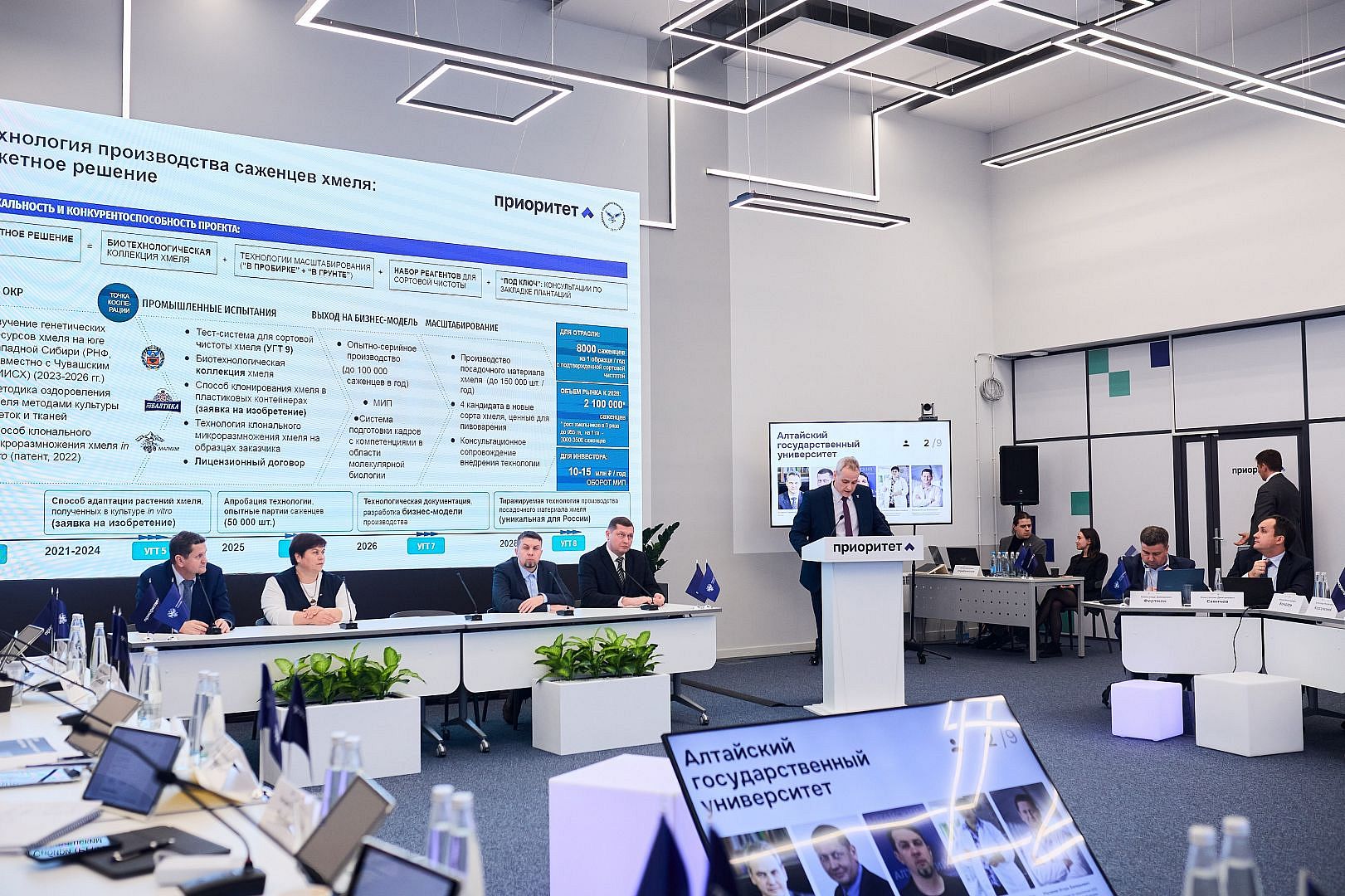



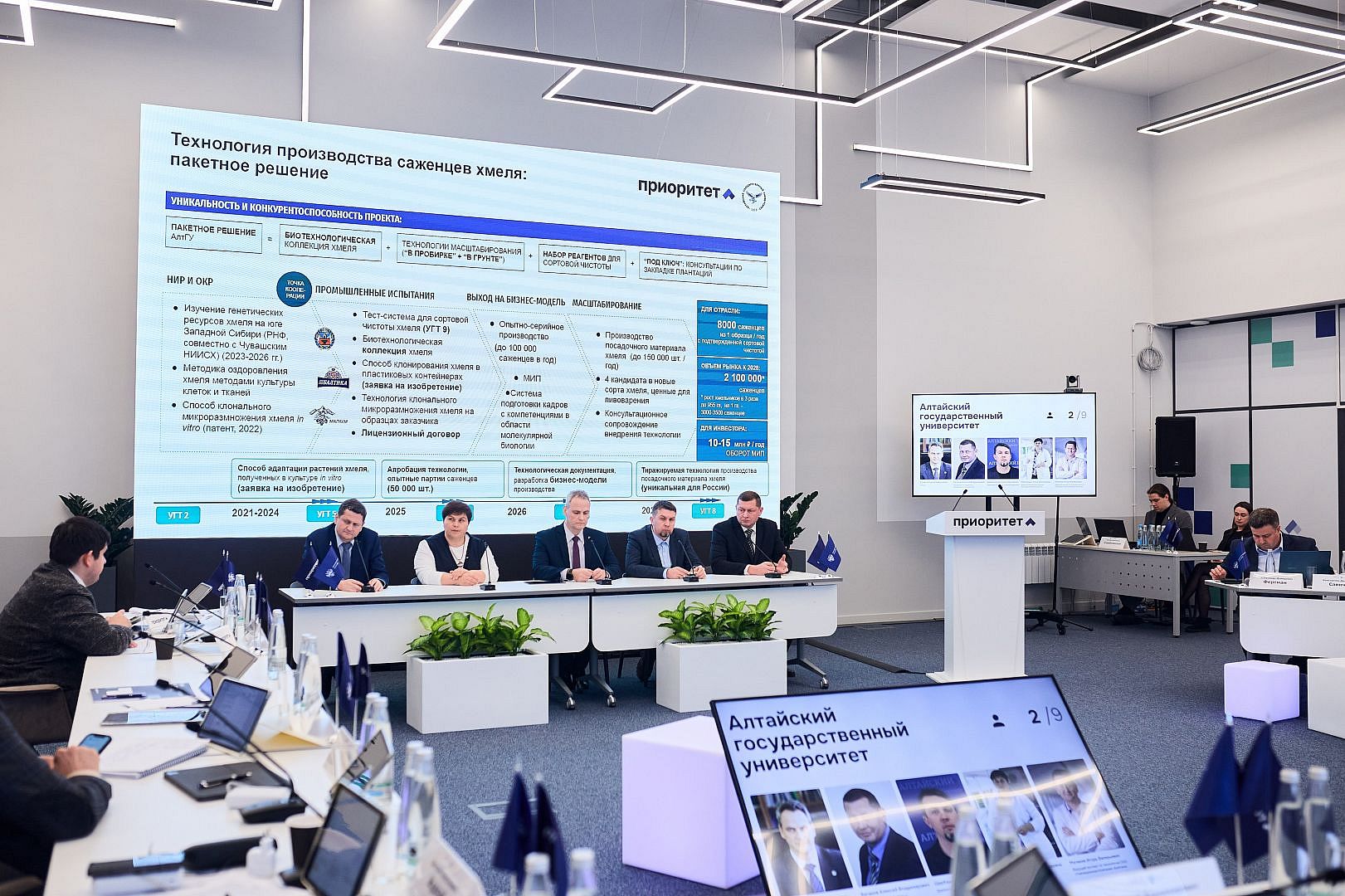


Altai State University’s delegation included Rector Sergey Bocharov, Vice-Rector for Scientific and Innovative Development, Alexey Vaganov, Director of the Altai State University Research Institute of Biomedicine and Head of the Strategic Technology Project "Biotechnological Engineering for Managing the Properties of Living Objects", Dmitry Shcherbakov, Director of the Altai State University Center for Applied Biotechnology and Head of the Project "Products and Technologies for Hop Growing and Medicinal Plant Growing," Olga Mironenko, and a representative of Altai State University's industrial partner, leading technology expert at the Baltika Brewing Company, Igor Matveyev.
In his report, Sergey Bocharov underscored that 2025 marked a pivotal year for the university, as it strategically focused its resources on advancing technological development. Detailing the outcomes of Altai State University's strategic technology project, he highlighted the following:
"Scientists at Altai State University have developed a biotechnological engineering platform designed for the accelerated creation of microorganisms with tailored properties. Its uniqueness lies in offering a seamless product development chain: from gene libraries and producer strains through genome editing to finalized biopharmaceuticals. The products introduced in 2025 include chymosin, lactase, astaxanthin, and Agrocin. Each of these represents a sophisticated solution tailored to specific production requirements of industry partners. I emphasize that the transfer of new biopharmaceuticals to customers is accompanied by current development of manufacturing technologies. Another key achievement relates to the university's contribution to revitalizing the domestic hop-growing sector. Today, the Russian brewing industry remains heavily reliant on imported hop." Given Russia’s potential not only for self-sufficiency but also for exporting this crucial raw material, a substantial supply of planting material is essential to revive hop cultivation. Altai State University pioneered a comprehensive set of methodologies in Russia, including clonal micropropagation, sanitation processes, and the creation of test systems to verify varietal purity. Efforts continue to expand the hop variety collection. In 2025 alone, 50,000 hop seedlings were delivered to industrial partners, including Baltika. Plans call for an annual capacity of 150,000 seedlings. This year has clearly demonstrated that a regional university has the capability to drive the growth of an entire industry.
Members of the Council for Support of University Development Programs posed questions not only to the university team but also to representatives of the university's industrial partners, as "Priority 2030" focuses specifically on the practical application of new technologies. The outcomes of the defenses of the universities participating in Priority 2030 will be announced in December of this year.