The laboratory of the South Siberian Botanical Garden at Altai State University (ASU) is the first in Russia to undertake targeted work with plant cytometry. Mikhail Skaptsov, Candidate of Biological Sciences and leading researcher, spoke to Vecherniy Barnaul about why Barnaul pioneered this method.
On the table in front of Mikhail Skaptsov are plant fragments in Petri dishes, ready for cytometric analysis. The plants themselves, grown in test tubes, were donated for study by Altai State University's Altai Center for Applied Biotechnology, which specializes in plant cloning. However, the University center is far from the only institution seeking the South Siberian Botanical Garden’s expertise.
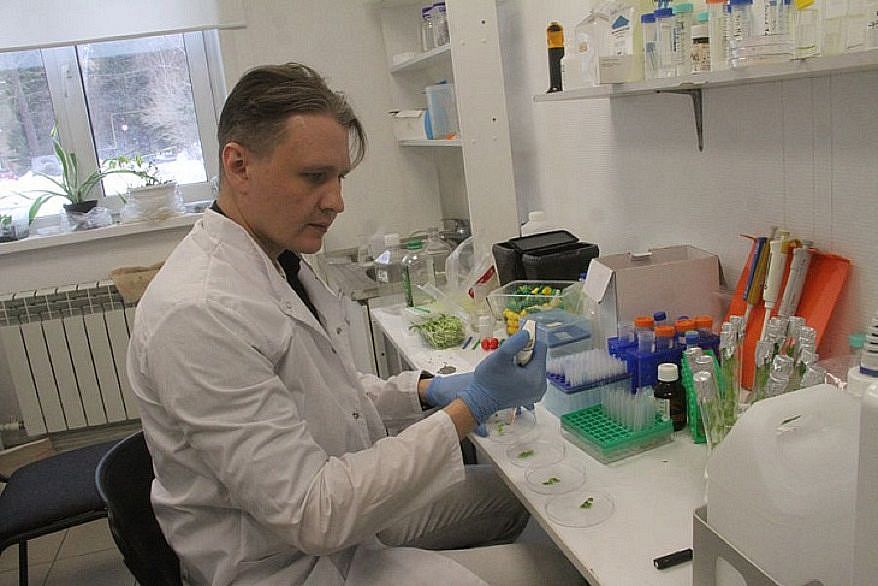
"As part of our joint projects, we receive material from across Russia—from Kaliningrad to the Far East," says Mikhail Skaptsov. "We were among the first in the country to specifically pursue this area. Previously, this method was rarely applied to plants. Even now, few laboratories offer this, although many of our staff either trained with us or commissioned studies here and later acquired their own equipment."
Broadly speaking, cytometry involves studying cell characteristics in a fluid flow. Working with animal cells has long been known. Later, the method was adapted for plants, mainly abroad. For some reason, it has not gained widespread acceptance in Russian practice. Why? Perhaps because plant cytometry relies not only on the entire cell, but on its nucleus, which is difficult to isolate.
The niche proved vacant – and, as time has shown, highly in demand.
The Barnaul scientist himself entered this field 13 years ago while working on his dissertation. His research focused on mutagenesis in in vitro culture. He investigated mutation accumulation in plants, using direct chromosome analysis as one of the methods.
"Under a microscope, you can examine a dozen slides in a day. With a cytometer, you can conduct a hundred or two hundred studies to identify the specific plant with the mutation. Then, under the microscope, you can examine in detail what happened," says Skaptsov.
When the first cytometer arrived in the lab, Mikhail began mastering it. Later, a more advanced research-grade device arrived, and the scientist began working with it. As experience accumulated and scientific publications emerged, collaborators for whom the Barnaul scientist's research was essential began to apper.
A method for great discoveries
Mikhail Skaptsov explains: plant cytometry isn't about making major scientific discoveries. But it is a method without which these very discoveries would not happen or would be delayed.
"There's only one such method, but it simplifies routine tasks for scientists and solves many problems, as it is applicable wherever DNA variability within the plant nucleus must be assessed. It enables highly accurate measurement of genome size and determination of plant ploidy level, that is, the number of identical sets of chromosomes in a cell. These data allow researchers to distinguish between closely related species, identify polyploid complexes, and study hybridization and speciation processes in general. Many questions can be answered with a single study," says the scientist.
But sometimes the opposite occurs—during research, something is discovered that scientists later have to explain and prove. Once, a species was studied, assumed to be diploid, but it turned out to be hexaploid. Simply put, the cell contained a different set of chromosomes than expected. At some point in its development, the plant underwent hybridization and chromosome doubling, and now researchers need to figure out how this happened.
Century-old leaf
Plant cytometry ideally uses living material. But in Russia, given its vast territory, this is difficult to achieve. Keep samples alive during multi-week expeditions prove challenging. Therefore, Barnaul scientists have already mastered proper fixation in chemical fixatives or drying techniques to ensure accurate further analysis. One day, the lab was studying a nearly century-old herbarium specimen—a club moss collected in Afghanistan and now held in the St. Petersburg Botanical Garden collection.
Cytometry allows samples to be kept alive. Microscopic examination would require cutting off a portion of the root, and if a seedling were used, the plant would likely die. However, cytometer requires only a small tissue fragment. If the data proves unique, the plant can be propagated and studied further.
The lab often works with seed collections, analyzing how long seed cells remain viable.
"When seeds haven't germinated, the cells can still be viable. If we're talking about endangered species, this research helps identify suitable material and propagate them," explains Mikhail Skaptsov.
Working with animal cells is relatively simple. Working with plants, whose cells need to be isolated for their nuclei, is more complex: numerous secondary, often specific, metabolites, polysaccharides, and other compounds interfere with analysis. And each species requires its own protocol for different developmental stages.
"And with some plants, this is simply impossible—for example, with strawberries. They contain substances that prevent the nuclei from being stained," explains Mikhail Skaptsov.
A school of their own
When the number of research requests at the South Siberian Botanical Garden laboratory grew high, they periodically held a school for young scientists in plant cytometry—a series of educational lectures and practical classes lasting three to four days. Over the past five years, many specialists from nearly all over Russia, representing universities and institutes of the Russian Academy of Sciences, have attended this school. And these aren't just botanists, but representatives of various fields—geneticists, physiologists, biochemists, and so on.
"There are many issues—from preparing the research material, which is not always straightforward, to interpreting the obtained data. "They're most often encountered by those new to plant cytometry, although even experienced users face difficulties. We discuss sample preparation in each specific case and common mistakes. At the same time, I remain available for my colleagues outside of our school," concludes Mikhail Skaptsov.