Altai State University is the only university in the region that has been a part of the Priority 2030 program for five years now, participating in the largest university development support program. At the end of November, the university reaffirmed its involvement by presenting its 2025 results and strategic plans for the coming years to the Council for Support of University Development Programs in Moscow. Rossiyskaya Gazeta provides the details.
Altai State University Rector Sergey Bocharov notes:
The Priority 2030 program has enabled a qualitative transformation of the university. Project management has reached a new level, and we have achieved strong results in scientific research. However, our main focus, of course, remains the implementation of the strategic technological project. Since 2025, the university has concentrated its resources on technological development. Our strategic project aims to create our own biotech research and implementation platform that integrates a range of complementary technologies: metabolic engineering, genomic research, digital technologies, clonal micropropagation, and others. The sophistication of our developments allows us to serve a wide range of customers, from lab-testing to production. Overall, our university's development strategy is aimed at advancing the bioeconomy of Altai Krai and Russia.
What has been accomplished
ASU scientists have developed a biotechnological engineering platform for rapidly designing microorganisms with targeted properties. Its uniqueness stems from its end-to-end product development chain: from gene libraries and producer strains, through genome editing to finished biopharmaceuticals. Products created in 2025 include chymosin, lactase, astaxanthin, and Agrocin. Each of these products represents a high-tech solution tailored to specific company needs. It is worth noting that the transfer of new biopharmaceuticals to customers includes the development of production technologies.
Dmitry Shcherbakov, Director of the ASU Research Institute of Biomedicine and Head of the ASU Strategic Technology Project, explains:
Recombinant enzyme producers are in high demand in the food industry: without them, it is impossible to produce cheeses, bakery products, juice syrups, or carbonated beverages. Previously, manufacturers relied on foreign biopharmaceuticals, but we are ready to offer domestic equivalents.
While producer technologies are well-established, each enzyme often takes years to develop. Our platform cuts this time by two to three times — from five to eighteen months. By leveraging the full experience of our experimental base, we've systematized numerous genetic elements to quickly and efficiently create the needed producers.
One of the first enzymes produced via the platform is a recombinant milk-clotting enzyme from yeast – today, one of cheesemaking’s most vital enzymes for milk coagulation.
Evgeniya Nikolaeva, Director of INGREDICO, emphasizes the uniqueness of this development:
The microbial chymosin obtained by Altai State University scientists is currently a unique development in Russia. Its implementation on an industrial scale will allow cheese-making enterprises to avoid the risks of external markets affecting the dynamics of enzyme reserves for production and will contribute to the implementation of a sustainable development system.
A sober approach to hop growing
Another important achievement concerns the university's role in reviving the domestic hop-growing industry. Today, Russian breweries remain heavily dependent on imported hop products. However, Russia has the potential not only to be self-sufficient but also to export this essential raw material. To restore hop gardens, large quantities of planting material are required.
Altai State University Rector Sergey Bocharov notes:
Altai State University was the first in Russia to develop a range of solutions encompassing clonal micropropagation, sanitation, and the development of test systems for determining varietal purity. Efforts are currently focused on expanding the collection of hop varieties. In 2025, the university delivered 50,000 hop seedlings to industrial partners, with plans to reach an annual production capacity of 150,000 seedlings. This year has demonstrated that the regional university can serve as a driving force for an entire industry.
Pilot batches of hop planting material developed by Altai State University scientists have already been planted in the Tula Oblast and the Altai Republic, and Chuvashia.
Olga Miroonenko, Director of the Altai Center for Applied Biotechnology at Altai State University, adds:
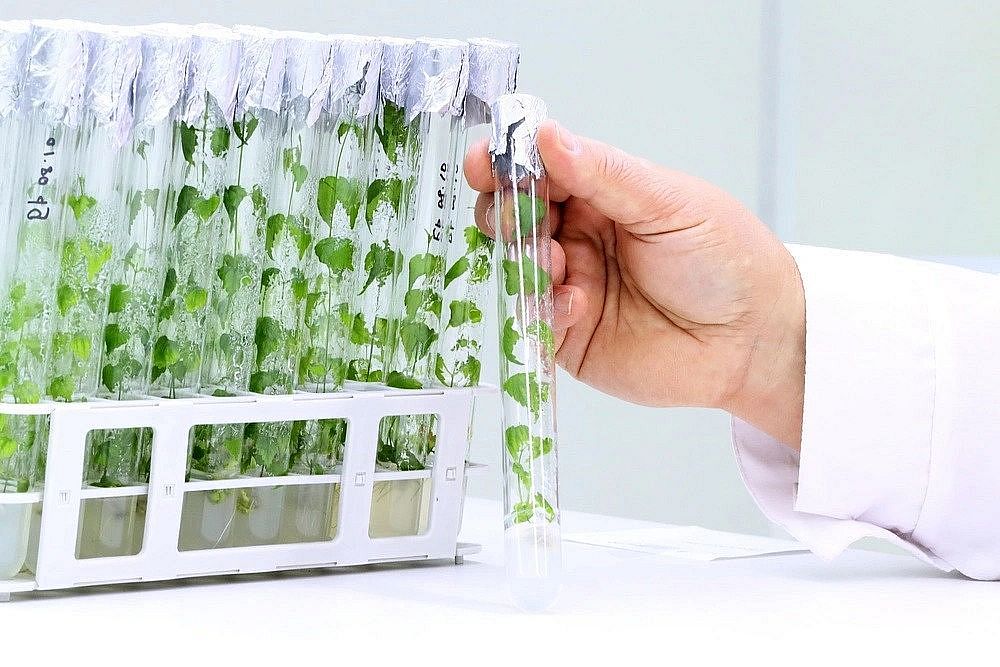
Currently, there are no nurseries in Russia that produce hop seedlings, and the small quantities propagated by hop growers are insufficient to establish new plantations. Reviving hop cultivation through traditional propagation methods using root and stem cuttings would take several decades! We offer an innovative solution: with our patented clonal micropropagation technology, we obtain 5 to 9 micro-cuttings per month from a single plant cutting, which we then replant in successive cycles. Our methods make it possible to produce up to 5,000 identical clones per year from a single sample. I should add that, in addition to replication, we test samples for viruses using modern PCR methods and select treatment technologies to ensure that we obtain only healthy plants.
This year, a team of Altai State University scientists compiled a unique biotechnological hop collection. The catalog includes over 50 genotypes: both known varieties and wild specimens, collected over three years of expeditions across Siberia, including in collaboration with industrial partners. If maintained in a nursery, this collection would require considerable space and labor, but in the Altai State University laboratory, all samples fit on a single shelf. Each of them can be used for scientific research or for producing batches of planting material, even during the winter.
Marker-assisted breeding technologies
Another notable project at Altai State University is called TomGen. It aims to develop a scientific and technological foundation for breeding and seed production, accelerate the breeding process, improve the quality and precision of research, and preserve, study, and expand tomato varieties. TomGen simplifies many of the breeders’ tasks and supports the development of domestic seed production.
Maxim Kutsev, Head of the Altai State University Office of Technology Leadership, explains:
As part of the Priority 2030 program, our developers have created the first specialized scanner in Russia equipped with a high-speed photosensor and software that allows for highly accurate varietal identification of plants within a single species. They are also developing a web service for identifying varietal affiliations, diseases, and plant conditions using computer vision.
We’ve adapted it to the specific needs of our industrial partner. We're training AI to distinguish apple and tomato varieties based on external morphological features, which will significantly simplify the work of plant breeders.
According to Maxim Kutsev, similar tools exist on the market, but they are typically limited in scope — for example, root scanners designed for particular varieties or diseases. The device developed by Altai State University scientists can analyze roots, seeds, and leaves — each researcher can customize the program to automatically identify specific plant parameters.
The TomGen package also includes a DNA barcoding service for variety identification and quality control, which enables genetic certification of tomato varieties. Furthermore, the team has applied to register a new tomato variety with improved traits, while three more are awaiting registration.
The name of the variety we submitted for registration is called Chile. This is because the seeds of wild tomatoes from that country served as the starting point for selection and breeding. The variety is similar to the well-known cherry tomato; the fruits are small, orange-red, and plum-shaped. Its key advantages are high sweetness, almost dessert-quality, and excellent shelf life, adds Sergei Smirnov, Candidate of Biological Sciences, Director of the Institute of Biology and Biotechnology at Altai State University.