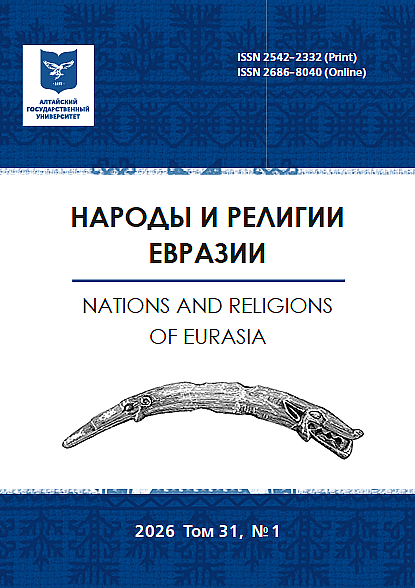
In April 2026, Altai State University's journal Peoples and Religions of Eurasia earned a top-tier Q1 ranking in the international scientific publication database Scopus, based on the 2025 indexing results. As a reminder, it was included in Scopus in 2023 and has gradually climed to the highest level.
The journal's editor-in-chief is Petr Dashkovsky, Doctor of Historical Sciences, Professor, and Head of the Department of Russian Regional Studies, National and State-Confessional Relations at the Institute of Humanities, Altai State University.

Petr Dashkovsky notes:
Our journal boasts a long history. Since 2007, we have annually published the collection titled Worldview of the Population of Southern Siberia and Central Asia in Historical Retrospect, featuring works on the archeology, ethnography, and religious studies of Central Asia. Since 2017, this collection evolved into the journal Peoples and Religions of Eurasia. In 2023, the journal was included in Scopus, and the fact that just three years later we have achieved the top Q1 quartile is an outstanding achievement. A scientific journal's quartile reflects its ranking based on bibliometric indicators. It is calculated using a specific methodology, primarily considering the citation rates, and in some cases, an author prestige, international authorship, and citations from other reputable journals. The very fact that we were able to climb to the top of the journal hierarchy, especially under rather challenging circumstances, is remarkable. This achievement was preceded by many years of work by our team and the support of our colleagues. We have assembled a strong editorial board of specialists in archeology, history, ethnography, and religious studies from 12 countries: Russia, Kazakhstan, Tajikistan, Kyrgyzstan, Uzbekistan, Mongolia, Turkmenistan, China, Germany, Japan, Bulgaria, and Azerbaijan. Over the past year, we have welcomed a significant number of colleagues to join the editorial board from various institutes of the Russian Academy of Sciences, as well as from the academies of sciences of Kazakhstan, Tajikistan, Turkmenistan, Azerbaijan, and Mongolia. These efforts have of course, had a positive impact on the journal's development.
Of course, it is important not only to achieve but also to maintain these high positions, especially since quartiles are reassigned annually.
I extend my gratitude to all editorial board members, the editorial and international councils, and reviewers from various scientific centers in Russia and abroad, whose consistent support drives the journal forward. I would especially like to acknowledge the work of the journal's technical secretary, my student Yegor Traudt, for handling daily routine technical tasks. Furthermore, throughout its development, the journal benefited from regular support from Larisa Nekhvyadovich, Director of the Institute of Humanities, and Alexey Vaganov, Vice-Rector for Research and Innovation. They recognize the value of the university’s highly ranked scientific publications in sustaining its position in prestigious international rankings, and enhancing its reputation in the scientific community.
The mission of the journal Peoples and Religions of Eurasia is to publish original articles on the ethnocultural, social, and religious history of the peoples of Eurasia from antiquity to modern ethnographic times, taking into account cutting-edge findings in archeology, ethnology, history, and religious studies. It also aims to advance scientific research and develop international collaboration within this field.
The journal aims to share the latest research on the historical dynamics of ethnic and religious processes in Eurasia, incorporating modern methodological and methodological approaches, drawing on a broad source base, including the introduction of new archaeological and historical sources, and sparking constructive discussion on contentious issues.
Articles cover archaeological sites, ethnocultural history, ethnic processes and cultures of Eurasia’s peoples, the history of proselytizing and traditional religions, and monitoring interethnic and interfaith relations in the regions of Russia and abroad. Special emphasis falls on historical and contemporary aspects of state-confessional and national policies.