Students from the Institute of Geography at the Altai State University are proposing to combat Colorado potato beetles not with chemicals, but with another insect – the Podisus bug. Their project has already received several awards at various conferences and acceleration programs, and this summer, the team plans to test their theoretical assumptions and calculations in practice. Read more in Vecherniy Barnaul's article.
Natural Cleaner
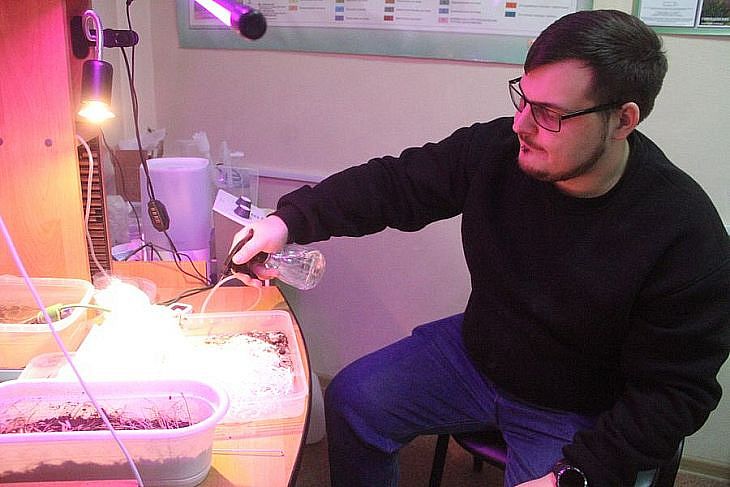

Colorado potato beetles are a common problem in vegetable gardens and patato fields. Some people collect the pests by hand, others spray chemicals on the crops, and some treat the tubers before planting. None of these methods are particularly safe, they tend to be labor-intensive, and not always effective. Since last autumn, the Altai State University student team called Green Tick has been developing a new method to control beetles in Altai Krai – using their natural enemy, the Podisus bug.
Green Tick, a team of students from the Department of Nature Management and Geoecology at Altai State University, designs projects focused on services for the biorestoration and control of agroecosystems. According to team leader Ilya Repetun, the idea of using bugs emerged last autumn during a seminar on entomophages – beneficial insects that prey on pests.
"Bugs originate in North America, where they successfully feed on beetles. We wondered: what if we tried breeding them here as an alternative to chemical treatments? The university launched the 'Business Innovators: Altai-Asia' acceleration program, and we developed a project for it. We received some feedback, but the overall idea was appreciated," says Ilya.
Gains and Losses
The idea, put it simply, is this: breed Podisus bugs in a laboratory and release them into potato fields in summer. While Colorado potato beetles have adapted to Siberian conditions and can successfully overwinter, bugs are capricious creatures. They enter a state of suspended animation during winter, but they cannot stand the cold and die, so we need to learn how to cultivate a stable population for each gardening season. This is exactly what students at Altai State University are currently working on.
"We found out that this method of pest control was previously used in the central regions of the Soviet Union," says Ilya. "In Russia, entomophages are studied at the All-Russian Research Institute of Plant Protection and the Institute of Applied Entomology. Some people breed them, and the Krasnodar company Biois even sells bug-rearing kits — but all of this is purely for entertainment, like home ant farms."
The students ordered two batches of forty kits from Krasnodar. Only five bugs from the first shipment arrived alive in Barnaul, and about 20 from the second. Nevertheless, after some time, about 70 individuals were crawling around in Petri dishes on the lab tables, with several generations successfully bred. Unfortunately, recent frosts dealt a serious blow to the bug population.
"It got cold in the room, the heaters weren't working properly, and we weren't there," says Nikita Pochyomin, senior lecturer in the Department of Nature Management and Geoecology and tutor-mentor for the Green Tick team. "As a result, we're down to three individuals now."
The students, however, remain optimistic. Ideally, they need around three thousand bugs by the summer season, so these three survivors have a serious task ahead. Green Tick plans to replenish their numbers with new kits from Krasnodar; they'll order them when the weather warms up. Even if they fall short of the target, a few hundred individuals will still be enough for the first experiments.
"We're currently testing various breeding, rearing, and feeding methods," says Ilya Repetun. "We feed them mealworms, which we raise ourselves. Ultimately, we aim for complete autonomy — with our own population, breeding stock, and food supply."
Turnkey Project
The plan for the gardening season is as follows: once conditions are favourable, we'll "land" the bugs on the first experimental potato plots.
Interestingly, the entomophages will quite literally will be landing. The Green Tick team includes several members, each responsible for their own field of work. Mikhail Rogalsky is currently developing equipment to distribute bugs, which will be a true innovation in itself. The team will receive a 3D printer to create it.
"Our plan is to disperse bugs using drones," Mikhail explains. "First, I studied similar devices — spreaders designed for 5-10 mm granules. Bugs are about the same size, but granules are hard, while the insects are soft and can be damaged, so we need different equipment. It already exists in digital form; we're just waiting for the 3D printer to produce the first prototype."
Those willing to test entomophages have already been found: three private farms owners in Kurye, Rubtsovsky District, and a gardening community in the village of Yuzhny. The plots are small, but the students believe that makes them ideal for initial experiments.
"We calculated that 25-30 individuals would be needed per 100 square meters," explains Ilya Repetun. "Bugs have a low migration rate, so they will remain within this area. We based our calculations on natural reproduction and mortality rates, without the need for additional reintroduction."
Podisus bugs feed on both Colorado potato beetles themselves, their eggs, and larvae, the latter even more actively. However, we will have to pay attention to temperature again—below 15°C, it's dangerous for them, the insects become sluggish. They can survive short-term cold spells, but unfortunately, prolonged cold spells are deadly.
"Siberia has its own species of shield bugs that tolerate the cold but are not predatory. In theory, we could try crossing them with Podisus to create frost-resistant entomophages, but that would take decades ND require a new laboratory, a testing station, and additional investment," explains Nikita Pochyomin.
Economic Calculations
At the same time, the students are assessing the economic viability of their project. So far, according to Timofey Boklanov, who is in charge for this part, the forecast is optimistic.
"I analyzed the cost and quantity of chemicals used to treat potato crops and compared them with the costs of cultivating and distributing the bugs," says Timofey. "According to our calculations, it will cost 600-1,000 rubles per 100 square meters of land with the required number of entomophages we've already discussed. This ensures 60-70 percent reduction of Colorado potato beetles, which is even higher than some popular products, and it is environmentally safe."
In parallel, in collaboration with the Institute of Mathematics and Information Technology at Altai State University, Green Tick is developing a neural network to assist in bug cultivattion.
"A webcam monitors the bugs in Petri dishes, and artificial intelligence records all observations — their movements, feeding habits, egg-laying, and periods of inactivity. We used to record all of this manually, and we still do. But with the neural network, analyzing the data, identifying patterns and adjusting their housing and feeding conditions, is becoming much easier. We're also working on a GIS tool to forecast the population dynamics and behavior of beetles and bugs in the field," says Nikita Pochyomin.
The goal of Green Tick is to offer services for biological restoration and ecosystem monitoring. Thus, the students are not only focusing on breeding entomophagous bugs, they are also experimenting with the artificial breeding of shield crabs used for cleaning water bodies.